
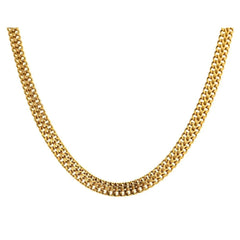



How do you untangle a necklace?
Open the clasp, lay the necklace flat, and gently loosen the knot before trying to draw the chain through it. Keep the chain supported and work on one loop at a time. If it takes force, stop: pulling the ends can tighten the knot or damage the links.
This guide is for a knot in an intact, flexible chain. A sharp bend, flattened section, broken link, or tangle in a strung pearl necklace needs a jeweler’s assessment.
Before you start: check the chain and its materials
Look closely under a bright light. Can you see loops crossing over one another, or does the metal itself look bent? Do not try to straighten a kink with pliers.
Check the necklace’s care instructions, including those for its pendant. A chain and its stones may need different treatment. GIA notes that pearls and other delicate or porous gems can be damaged by chemicals. If you cannot identify the materials, skip household liquids and powders and ask a jeweler. Read GIA’s jewelry-care guidance.
What you will need
- A clean, smooth, light-colored work surface with good lighting.
- A magnifying glass, if the links are difficult to see.
- A clean wooden toothpick for a visible opening your fingers cannot reach. Do not force it between tightly packed links.
Work away from a sink or an open drain. Keep the whole necklace on the surface so its weight is not hanging from the knot.

Untangle the necklace, one loop at a time
- Undo the clasp. Open it normally, without pulling against the knot. Remove a pendant only if it slides off freely; do not force it over the tangle.
- Spread out the loose chain. Make room around the knot. Leave slack on both sides instead of stretching the ends apart.
- Loosen an opening. Try your fingertips first. If you can see a gap, gently nudge the loop with the toothpick. The aim is to make space inside the knot—not to pry a metal link open. If the tip will not fit easily, stop.
- Ease one loop free. Follow where that section of chain crosses the others. Guide it back through the opening without tugging. If the knot becomes smaller or tighter, release the tension and reassess.
- Check before wearing. Once separated, inspect the links and clasp. A stretched link, rough spot, or clasp that no longer closes properly needs attention before you put the necklace on.
These steps use the flat-surface, gentle-loosening approach described in Jewelers Mutual’s guide and Pixie Wing’s chain-untangling guidance. There is no need to try every household trick if the knot resists.
What if it is still tangled?
Two necklaces are tangled together
Open both clasps and lay both necklaces flat. Trace one chain from its clasp toward the crossing point. Work on a visible loose loop, then move the freed section aside. Do not pull the necklaces in opposite directions.
The knot is too tight to see an opening
Stop rather than pushing in a needle, squeezing with pliers, or hanging and shaking the chain. Take the necklace to a jeweler, particularly if it is very fine, valuable, or sentimental. You do not need to exhaust every DIY method first.
Should you use baby oil, powder, or soapy water?
Some untangling guides suggest them, but they are not a universal next step. Suitability depends on the finish, stones, and construction, as well as how you will remove the residue. Follow the maker’s care instructions or ask a jeweler before applying anything. In particular, do not assume advice for a plain metal chain also applies to pearls; GIA’s pearl-care guide explains their different care needs.
How to keep necklaces from tangling in storage
Close the clasp and give each necklace its own place. Use a separate compartment, a suitable necklace holder, or the original fitted box. Avoid dropping several loose chains into the same pocket or pouch. Before traveling, check that each chain is secured and cannot slide into the others.

If you are in a hurry: put the tangled necklace somewhere secure and wear another piece. A knot that needs careful work is better left for later than pulled tighter on the way out.